Primary 1 Registration in Singapore: Phases, Distance and Balloting (2027 Guide)
Published 22 Oct 2026Updated 25 Oct 2026Little Buddy Team
Sometime in the year your child turns five, a parent in your chat group will post a screenshot of a map with a red circle on it. Within minutes, three people will announce they are "just outside 1km", one will mention a cousin's friend who "got in by ballot", and someone will say a school is "definitely safe this year", without a single source. You'll nod along while quietly opening a spreadsheet.
Take a breath. P1 registration is a rules-based system, not a rumour-based one. Once you know the phases, the distance bands and how balloting works, you can work out your own odds in an evening. Then you can ignore the chat group with a clear conscience.
What is P1 registration, and who takes part?
Primary 1 registration is how children get a place in a mainstream primary school for the following year. For Singapore Citizens (SC) and Permanent Residents (PR), it runs online over five phases: Phase 1, 2A, 2B, 2C and 2C Supplementary. International students go through a separate two-step process that leads to Phase 3, after citizens and permanent residents have been placed.
A parent registers on MOE's P1 Registration Portal with Singpass. Only one parent needs to log in and submit, and that parent declares the other parent's consent. You can register for only one school in any phase. If you submit more than once in that phase, MOE takes your latest submission.
Eligibility is by birth date. For the 2026 exercise, children born from 2 January 2020 to 1 January 2021 (inclusive) took part. By the same one-year pattern, the 2027 exercise would cover children born from 2 January 2021 to 1 January 2022. MOE's overview still showed only the 2026 range when we checked on 25 October 2026, so that 2027 range is a pattern, not a published date. Confirm it with MOE.
The P1 registration phases, explained
Think of the phases as a queue with several doors. The earlier doors are for children with a particular connection to a school. The last doors are open to everyone. Most families end up at one of the open ones, and that is completely normal.
Who qualifies, from the phase tabs on MOE's phases page, checked 25 October 2026. The timing column is the yearly pattern, not a set of fixed days. Use MOE's phase checker for your own child.
Phase 1
- Who it's for
- A sibling is studying in the primary school. MOE offers a place to every eligible applicant. This phase does not ballot.
- Typical timing in the year
- Starts around the end of June or start of July. Results about a week later.
Phase 2A
- Who it's for
- A parent or sibling is a former student of the school; a parent is a member of the School Advisory or Management Committee; a parent is a staff member of the school; or the child is studying in the MOE Kindergarten in that primary school.
- Typical timing in the year
- Early to mid-July.
Phase 2B
- Who it's for
- A parent volunteer who joined by 1 July of the year before registration and completed at least 40 hours by 30 June of the registration year; a parent endorsed by the church or clan directly connected to the school; or a parent endorsed as an active grassroots leader. The grassroots route is only for a school within 2km, and it carries a 30-month stay. MOE reserves 20 places in each school for this phase under the current framework.
- Typical timing in the year
- Mid to late July.
Phase 2C
- Who it's for
- Any child who is not yet registered in a primary school. No prior connection is required. Under the current framework MOE reserves 40 places in each school. A few schools cap permanent resident intake.
- Typical timing in the year
- Late July to early August.
Phase 2C Supplementary
- Who it's for
- A child who is still not registered after Phase 2C. If this phase is also unsuccessful, MOE posts the child to a school with a vacancy. A few schools cap permanent resident intake here too.
- Typical timing in the year
- Mid-August.
Phase 3
- Who it's for
- International students, after a separate two-step process, and only after citizens and permanent residents have been placed. A place is not guaranteed.
- Typical timing in the year
- After the SC/PR phases. The whole exercise can run into October.
| Phase | Who it's for | Typical timing in the year |
|---|---|---|
| Phase 1 | A sibling is studying in the primary school. MOE offers a place to every eligible applicant. This phase does not ballot. | Starts around the end of June or start of July. Results about a week later. |
| Phase 2A | A parent or sibling is a former student of the school; a parent is a member of the School Advisory or Management Committee; a parent is a staff member of the school; or the child is studying in the MOE Kindergarten in that primary school. | Early to mid-July. |
| Phase 2B | A parent volunteer who joined by 1 July of the year before registration and completed at least 40 hours by 30 June of the registration year; a parent endorsed by the church or clan directly connected to the school; or a parent endorsed as an active grassroots leader. The grassroots route is only for a school within 2km, and it carries a 30-month stay. MOE reserves 20 places in each school for this phase under the current framework. | Mid to late July. |
| Phase 2C | Any child who is not yet registered in a primary school. No prior connection is required. Under the current framework MOE reserves 40 places in each school. A few schools cap permanent resident intake. | Late July to early August. |
| Phase 2C Supplementary | A child who is still not registered after Phase 2C. If this phase is also unsuccessful, MOE posts the child to a school with a vacancy. A few schools cap permanent resident intake here too. | Mid-August. |
| Phase 3 | International students, after a separate two-step process, and only after citizens and permanent residents have been placed. A place is not guaranteed. | After the SC/PR phases. The whole exercise can run into October. |
Phase 1 has no balloting. MOE says every eligible Phase 1 applicant is offered a place. Balloting can happen from Phase 2A onwards, whenever applicants outnumber places. If your application in a phase doesn't succeed, you can register your child again in the next phase they're eligible for. If your child is still unplaced after Phase 2C Supplementary, MOE posts them to a school that has vacancies.
The short version: if you have no tie to a particular school, you're a Phase 2C family. That's the biggest door, and it's the one getting wider.
MOE's 2027 framework overview uses "active community leader" for the Phase 2B parent the phases page calls an endorsed active grassroots leader, and it marks that eligibility as unchanged. Use the phase checker in the year you register, not a screenshot of this table.
When does P1 registration happen? The yearly pattern
The pattern is stable even though the dates move. In the 2026 exercise, registration opened at the end of June with Phase 1. Phases 2A and 2B followed through July. Phase 2C ran from late July into early August. Phase 2C Supplementary came in mid-August. Each window opened at 9am and closed at 4.30pm, and results came back several days later. MOE's 29 April 2026 press release set that whole exercise from 30 June 2026 to 30 October 2026, which is long enough to include Phase 3. Treat the shape as the pattern. Do not treat the days as next year's calendar.
Here is how that looked in the 2026 exercise, shown as an example of the pattern only:
2026 Primary 1 Registration Exercise only, for children starting Primary 1 in 2027. Copied from MOE's phases page on 25 October 2026, where MOE labels the dates as that year's exercise, for reference. These are not the 2027 dates. Each window ran from 9am on the first day to 4.30pm on the last.
Phase 1
- Registration window (2026)
- 30 June – 2 July
- Results (2026)
- 8 July
Phase 2A
- Registration window (2026)
- 9 – 10 July
- Results (2026)
- 17 July
Phase 2B
- Registration window (2026)
- 20 – 21 July
- Results (2026)
- 27 July
Phase 2C
- Registration window (2026)
- 28 – 30 July
- Results (2026)
- 11 August
Phase 2C Supplementary
- Registration window (2026)
- 17 – 18 August
- Results (2026)
- 27 August
| Phase | Registration window (2026) | Results (2026) |
|---|---|---|
| Phase 1 | 30 June – 2 July | 8 July |
| Phase 2A | 9 – 10 July | 17 July |
| Phase 2B | 20 – 21 July | 27 July |
| Phase 2C | 28 – 30 July | 11 August |
| Phase 2C Supplementary | 17 – 18 August | 27 August |
Two things are worth doing before registration opens, not during it. First, check your home-school distance category. MOE's address page asks you to check the confirmed category in June 2027, before the 2027 exercise. Second, if you plan to use a caregiver's address, such as a grandparent's, you submit a declaration and you need MOE's approval email before you can register. On the address page, the 2026 declaration window needed at least three working days, and it closed before Phase 2C opened. MOE has not published a 2027 declaration window.
What's changing for the 2027 exercise
If you've heard the 2027 exercise is "different", you heard right. MOE has announced changes taking effect from the 2027 P1 Registration Exercise, for children who start Primary 1 in 2028. The stated aim is to improve access for children with no prior connection to a school, and to encourage more mixing between students from different backgrounds. There are two changes.
At most schools, the open door gets a bit wider. At 12 schools, living a little further away stops counting against you inside Phase 2C.
2027 changes, from MOE's changes page (updated 11 September 2026), the 10 September 2026 press release, and Annex B. These are the announced rules for that exercise, not a permanent timetable.
Phase 2C reserved places
- What MOE has published
- Rises from 40 to 60 at schools with a Primary 1 intake of 180 or more. Schools with a Primary 1 intake below 180 are excluded from the increase. Annex B says those smaller-intake schools stay at 40 Phase 2C places.
Phase 2B reserved places
- What MOE has published
- Stays at 20. The 10 September 2026 press release says this in the announcement. Annex B marks the Phase 2B reserve as unchanged.
Places left after Phase 2A
- What MOE has published
- One-third still goes to Phase 2B and two-thirds to Phase 2C. After Phase 2B, leftovers go to Phase 2C.
| Rule from the 2027 exercise | What MOE has published |
|---|---|
| Phase 2C reserved places | Rises from 40 to 60 at schools with a Primary 1 intake of 180 or more. Schools with a Primary 1 intake below 180 are excluded from the increase. Annex B says those smaller-intake schools stay at 40 Phase 2C places. |
| Phase 2B reserved places | Stays at 20. The 10 September 2026 press release says this in the announcement. Annex B marks the Phase 2B reserve as unchanged. |
| Places left after Phase 2A | One-third still goes to Phase 2B and two-thirds to Phase 2C. After Phase 2B, leftovers go to Phase 2C. |
The second change is a Two-Track Scheme in Phase 2C at 12 schools, in neighbourhoods where public housing makes up less than 40% of dwelling units within 2km. Phase 2C places at these schools are split equally between two tracks: children living within 2km, and children living beyond 2km. There is no home-school distance priority within each track. Singapore Citizen applicants are admitted before permanent resident applicants. If a track has more SC applicants than places, MOE ballots. If one track doesn't fill, the spare places go to SC applicants in the other track. If the number of places is odd, the extra place goes to the within-2km track. If places remain after every SC applicant is admitted, permanent residents can be considered, and those remaining places are split equally between the two tracks.
MOE's 10 September 2026 announcement lists the 12 schools in Annex A. MOE says it will review the list, and that it does not expect frequent changes. The names below are that annex, not a guess.
The 12 Two-Track Scheme schools, from MOE Annex A, with effect from the 2027 P1 Registration Exercise. Addresses are as printed in that annex.
Anglo-Chinese School (Junior)
- Address in Annex A
- 16 Winstedt Road, Singapore 227988
Anglo-Chinese School (Primary)
- Address in Annex A
- 50 Barker Road, Singapore 309918
CHIJ (Katong) Primary
- Address in Annex A
- 17 Martia Road, Singapore 424821
Methodist Girls' School (Primary)
- Address in Annex A
- 11 Blackmore Drive, Singapore 599986
Nanyang Primary School
- Address in Annex A
- 52 King's Road, Singapore 268097
Ngee Ann Primary School
- Address in Annex A
- 344 Marine Terrace, Singapore 449149
Pei Hwa Presbyterian Primary School
- Address in Annex A
- 7 Pei Wah Avenue, Singapore 597610
Raffles Girls' Primary School
- Address in Annex A
- 21 Hillcrest Road, Singapore 289072
Singapore Chinese Girls' Primary School
- Address in Annex A
- 190 Dunearn Road, Singapore 309437
St. Margaret's School (Primary)
- Address in Annex A
- 136 Sophia Road, Singapore 228197
Tanjong Katong Primary School
- Address in Annex A
- 10 Seraya Road, Singapore 437259
Tao Nan School
- Address in Annex A
- 49 Marine Crescent, Singapore 449761
| School | Address in Annex A |
|---|---|
| Anglo-Chinese School (Junior) | 16 Winstedt Road, Singapore 227988 |
| Anglo-Chinese School (Primary) | 50 Barker Road, Singapore 309918 |
| CHIJ (Katong) Primary | 17 Martia Road, Singapore 424821 |
| Methodist Girls' School (Primary) | 11 Blackmore Drive, Singapore 599986 |
| Nanyang Primary School | 52 King's Road, Singapore 268097 |
| Ngee Ann Primary School | 344 Marine Terrace, Singapore 449149 |
| Pei Hwa Presbyterian Primary School | 7 Pei Wah Avenue, Singapore 597610 |
| Raffles Girls' Primary School | 21 Hillcrest Road, Singapore 289072 |
| Singapore Chinese Girls' Primary School | 190 Dunearn Road, Singapore 309437 |
| St. Margaret's School (Primary) | 136 Sophia Road, Singapore 228197 |
| Tanjong Katong Primary School | 10 Seraya Road, Singapore 437259 |
| Tao Nan School | 49 Marine Crescent, Singapore 449761 |
How home-school distance works
When a school has more applicants than places in a phase, MOE decides who gets priority using citizenship and home-school distance. An SC outside 2km still comes ahead of a PR within 1km. That surprises people.
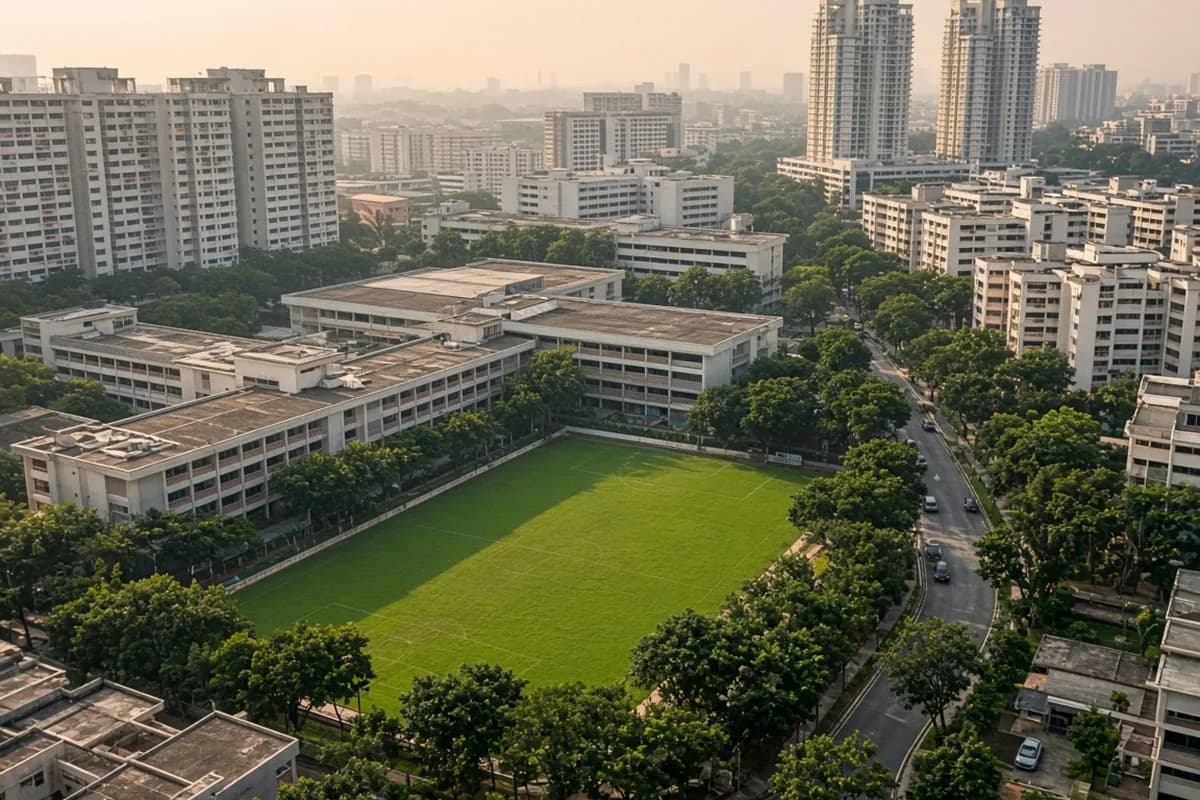
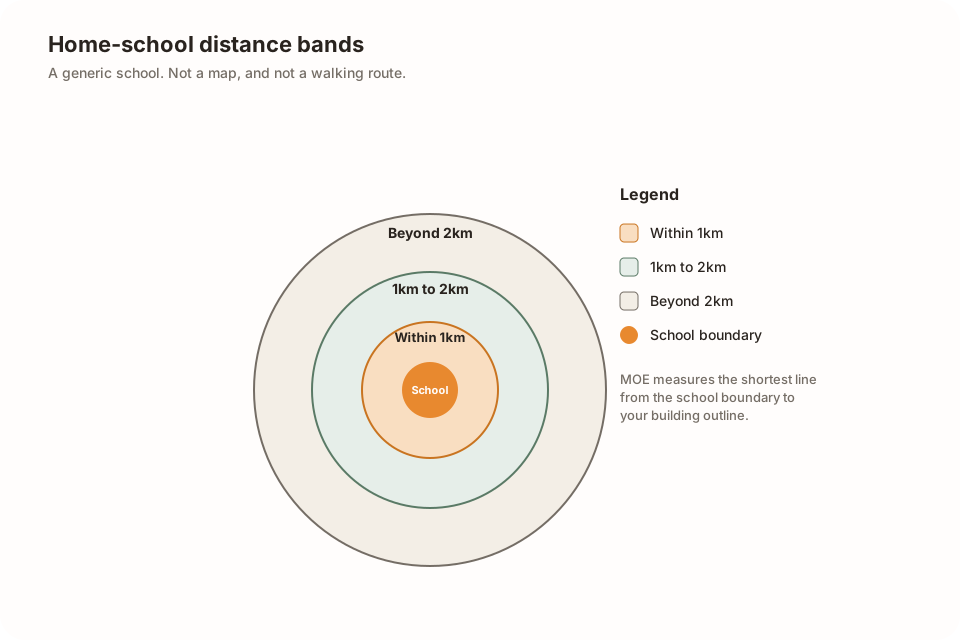
Priority when a phase has more applicants than places, from MOE's distance page and balloting page. At the 12 Two-Track schools, Phase 2C does not use this distance order inside a track.
1
- Who
- Singapore Citizens living within 1km of the school
2
- Who
- Singapore Citizens living between 1km and 2km
3
- Who
- Singapore Citizens living outside 2km
4
- Who
- Permanent Residents living within 1km
5
- Who
- Permanent Residents living between 1km and 2km
6
- Who
- Permanent Residents living outside 2km
| Priority | Who |
|---|---|
| 1 | Singapore Citizens living within 1km of the school |
| 2 | Singapore Citizens living between 1km and 2km |
| 3 | Singapore Citizens living outside 2km |
| 4 | Permanent Residents living within 1km |
| 5 | Permanent Residents living between 1km and 2km |
| 6 | Permanent Residents living outside 2km |
Three practical points on how distance is measured.
It's not the route you walk. MOE uses the shortest distance from any point on the school's boundary to the building outline of your registered residential address, taken from the building plan. Your phone's walking time to the school gate tells you nothing about your category. A condo and an HDB flat are measured the same way. Housing type is not its own category.
Don't trust a screenshot, including this page. Use the distance checker on MOE's address page, which uses the Singapore Land Authority's OneMap School Query, with your own postal code. MOE warns that your category can change from year to year, for example when updated building plans change a building's outline or when school boundaries change. The same page asks you to check your confirmed category in June 2027, before the 2027 exercise. If you are looking at Kranji Primary School's new Tengah campus for that exercise, MOE has also published an indicative distance note on that page.
The address has to be real, and you have to stay. The address used should be the parents' official residential address as shown on their NRICs. If your child gets in through the distance category, MOE expects you to live at that address for at least 30 months from the start of the P1 registration exercise. For the 2026 exercise, that start is 30 June 2026. For a new property, the 30 months run from the day you move in. For a resale, they run from the start of your child's Primary 1 term. If you can't show that you've met this, MOE can transfer your child to another school, and it chooses which one. MOE also checks addresses, and giving false information is an offence that is referred to the police. This isn't the place for creative geography.
How balloting works
Balloting happens when applicants outnumber the places in a school in a given phase, anywhere from 2A to 2C Supplementary. It's computerised, run centrally by MOE, and everyone who has to ballot has an equal chance.
"Equal chance" has a specific meaning. The priority order above is applied first. Imagine a school has 30 places left in Phase 2C. If there are 20 SC applicants within 1km, they get in. The remaining 10 places go to the next group down, and if that group is bigger than 10, only that group ballots. Groups below it get nothing in that phase. Distance doesn't decide who wins within a group, but it decides which group you're in. For most people, that is the whole drama. The 30 and the 20 are an illustration, not a vacancy MOE has published.
MOE's vacancies page updates the number of vacancies and applicants during each phase. After a phase closes, MOE lists the schools that require a ballot. A few schools also cap permanent resident intake in Phases 2C and 2C Supplementary. That cap is not a rule for every school.
How to choose schools without losing sleep
Here's the opinionated bit. The most useful thing you can do is choose schools you could realistically get, rather than the one the chat group won't stop talking about.

MOE makes this easier than the chat group does. Its overview points you to the 2025 Vacancies and Balloting Data Checker: schools near your home where every applicant in your phase was admitted in 2025. MOE says to consider those schools. Pair that with the vacancy figures for the exercise you are actually in, and look at schools within a distance you can live with on SchoolFinder. Then be honest about the commute. A school that's slightly less glamorous but ten minutes closer is a school you'll still like in Primary 4.
Also note that MOE says it will gradually reduce the Primary 1 intake for most primary schools over the next few years, starting from the 2026 exercise, because the cohorts entering Primary 1 are smaller. That line is in the 29 April 2026 press release. Vacancy numbers can move from year to year, so don't plan around last year's numbers alone.
What if you don't get your first-choice school?
First, it's a process, not a verdict. If your application in a phase is unsuccessful, you can register in the next phase your child is eligible for. For most families that means going from Phase 2C to Phase 2C Supplementary, where the vacancy page will show you what's left. If you're still unplaced after that, MOE posts your child to a school with vacancies.
Decide your Plan B before you click submit, not after results day. MOE itself asks you to decide the school well ahead, because a withdrawal or an amendment can delay you or cost you a registration phase. A second submission inside the same phase replaces the first. A calm conversation at home in May beats a panicked one at 11pm in July.