MOE Kindergarten vs Private Preschool in Singapore
Published 27 Oct 2026Updated 27 Oct 2026Little Buddy Team
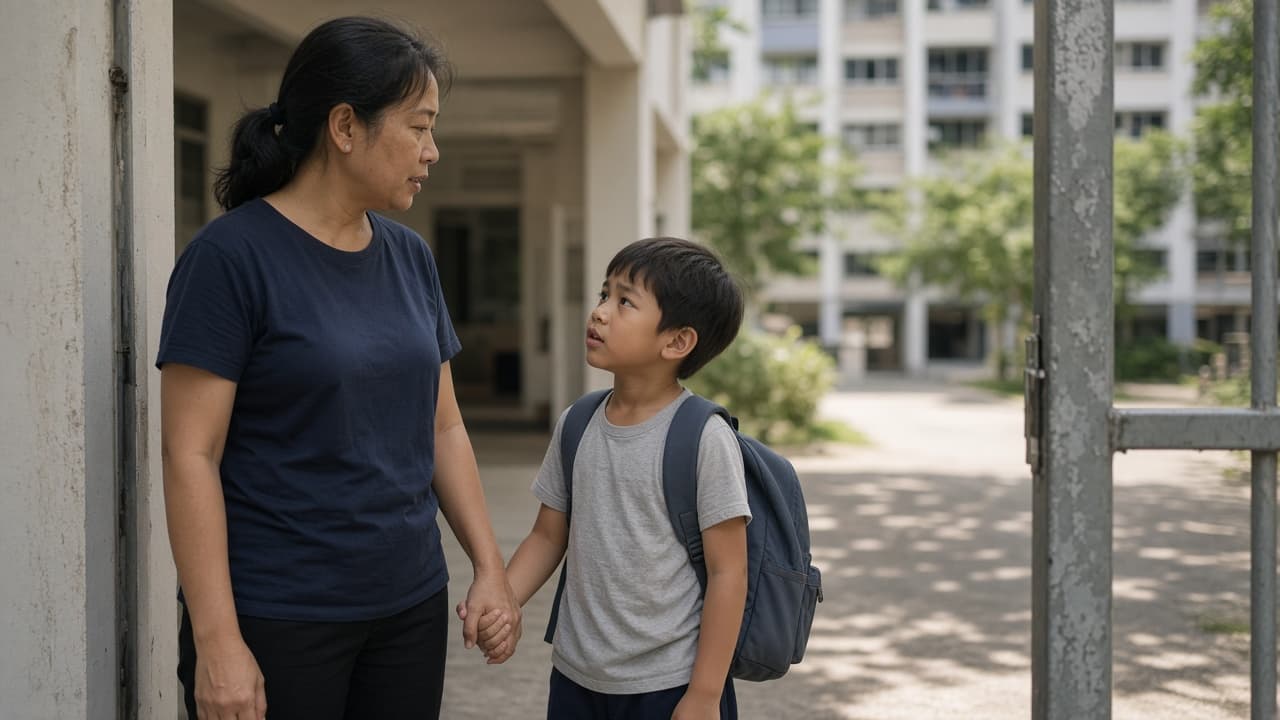
If you are weighing MOE kindergarten vs private preschool, you already know the moment. It is 9.40pm, the corridor outside the flat is quiet, and the parent chat has a photo of a primary school gate. Someone says the kindergarten is the move because of Primary 1. Someone else says a cousin pays three thousand a month and the child can already write their name. A third asks whether a three-year-old who still naps should already be enrolled.
Short answer: sometimes the kindergarten, and less often than that chat suggests. Choose from the hours you actually have, and from a place you can get. A brochure that says holistic is not a tie-breaker. Neither is a rumour that four hours in K1 buys the primary school next door.
What an MOE Kindergarten actually is
MOE Kindergarten is the Ministry of Education's own K1 and K2, for Singapore citizens and permanent residents. The session is four hours: 8am to 12pm, or 1pm to 5pm. It is located in a primary school. It does not take infants, and it does not take nursery. If your child is still napping after lunch, this is not the programme in front of you.
Kindergarten Care is the wraparound, at every MK, in the same premises, until 7pm on weekdays. It includes meals and play. It is closed on public holidays, Teachers' Day, Children's Day, and up to six further days a year. You indicate KCare when you register, or you ask the centre head later. It is a second fee. The 2026 session fee on MOE's fee page is $160 a month for a citizen and $320 for a permanent resident, including June and December, with no extra charge for field trips. The KCare page sets a 2026 maximum of $425 a month, also charged in those holiday months. Citizens receive $150 in basic KCare subsidy. Anything further is tiered by income on MOE's calculator. There is no single further amount to quote.
KiFAS can reduce the session fee for a citizen child. It does not reduce KCare. The childcare subsidy is a different scheme, for licensed infant care and childcare. KiFAS sits with the other financial assistance for parents. Uniforms are a separate purchase from the monthly fee. From January 2027, MOE says the income eligibility of preschool subsidies will rise. The new bands are not on the fee page yet.
You register for one MK. A second application does not help: MOE keeps the latest one. The online window for K1 in 2027 ran from 9am on 23 March 2026 to 4.30pm on 31 March 2026. It has closed. Children in that exercise were born from 2 January 2022 to 1 January 2023, both dates inclusive, and MOE said parents would hear by 1 June 2026. The register page now says the outcome comes about two months after the window closes. If you missed it, contact that MK. Places from the window go first. A later form waits on a vacancy, and you are waitlisted if there isn't one. K2 is vacancy-only. The next window is not published on the pages checked on 27 October 2026.
An MK generally takes up to about 140 children. In the 2026 exercise, 57 kindergartens took part, including MK@Rivervale, which opens in 2027. That is the count for that exercise, not a permanent map of the island. Open Admissions, for a child who is not coming through a partner early-years centre, follows the order on MOE's priority page. One-third of places are reserved for citizen children living within 1km whose household income does not exceed $4,500 a month, or $1,125 per person. Then siblings already in K1 to Primary 6 at that MK or its primary school, citizen or permanent resident. Then other citizens. Then permanent residents. Inside those last two groups, a child whose parent works at the MK or the school is considered first. That staff line does not jump ahead of the reserved places or the siblings. If applicants outnumber places, the ballot uses distance: within 500m, then 500m to 1km, then 1km or more.
There is a second door. Eligible children at partner early-years centres run by E-Bridge, My First Skool, or PCF Sparkletots are offered a K1 place at a partner MK. The child has to be enrolled by 15 March of Nursery 2, and you have to register that partner during the exercise. MOE's MK-EYC page says a non-partner MK is ordinary Open Admissions. Clusters, where one centre partners with a few MKs, are in Ang Mo Kio, Jurong West, Punggol, Sembawang, and Tampines. The offer is a partner place. It is not a place at whichever MK sits in the primary school the chat group prefers.
The curriculum is MOE's own. Purposeful play, experiences in Singapore, and English plus Chinese, Malay, or Tamil. The February 2026 press release says every MK offers all three mother tongues. That is a real programme. It is not a ranking against every other centre on the island, and the word holistic on a poster does not make it one.
What private and anchor centres actually cover
If your child is two, the decision in front of you is not an MK. MK starts at K1. A full-day centre is what covers the years before that, and the workday after the four-hour session ends.
Anchor Operators and Partner Operators are ECDA-funded centres with a citizen fee cap. From 2026, the anchor cap is $610 a month before GST for full-day childcare, $1,235 for full-day infant care, and $150 for a kindergarten programme. The partner childcare cap is $650 a month before GST. A private centre sets its own fee. There is no national cap. A licensed childcare place can still be assessed for the childcare subsidy, paid to the centre, and that subsidy does not pull a private fee down to the anchor cap. A kindergarten session at an anchor centre, like MK, uses KiFAS rather than the childcare subsidy.
Licensed preschools share ECDA's curriculum frame. The day on top of that frame is the operator's: inquiry, stories, two languages, a campus with a nurse. None of those words is a score. Named centres, branch fees, and what parents argue about are in the best preschools guide. This page is the category, not another tour of brands.
An anchor centre near the MRT you already use is often the place that exists before K1, with a vacancy and a closing time that survives a late meeting. A private kindergarten in a mall you drive past is a particular room at a particular price. It does not become the careful choice because the brochure says P1-ready.
MOE kindergarten vs private preschool, side by side
The chat group says private and means two different bills. An anchor centre with a fee cap and a campus that sets its own fee are not the same offer. The middle column is the capped centre. The last column is everyone else.
Published 2026 figures for a Singapore citizen child, checked 27 October 2026. MK and KCare amounts include June and December. Anchor and partner caps are before GST and before subsidy. A private fee is the centre's own. Confirm the invoice. Sources: MOE fees, KCare, anchor caps, and partner caps.
Fees
- MOE Kindergarten
- $160 a month for the session. KCare is separate, up to $425 before the $150 citizen basic subsidy. KiFAS can apply to the session only.
- Anchor or partner centre
- Full-day childcare capped at $610 a month before GST at an anchor centre, and $650 before GST at a partner centre. An anchor kindergarten session is capped at $150 before GST.
- Private preschool
- The centre sets the fee. There is no ECDA cap. Published examples differ by campus. Use the preschool guide rather than a single number.
Ages covered
- MOE Kindergarten
- K1 and K2 only, for citizens and permanent residents. About the years a child turns five and six.
- Anchor or partner centre
- Infant care through K2 where that centre runs them. Not every branch has every level.
- Private preschool
- Often playgroup or nursery through K2. Infant care only where the campus offers it.
How you get a place
- MOE Kindergarten
- One application. A fixed window, then a waitlist. An MK generally takes up to about 140 children. The 2026 exercise had 57 MKs.
- Anchor or partner centre
- Register with the centre, often months ahead. A partner early-years centre can offer a later place at a partner MK if you meet the 15 March Nursery 2 date.
- Private preschool
- Ask the campus. Vacancies move. A deposit and a notice period are common. There is no national ballot.
Curriculum
- MOE Kindergarten
- MOE's K1 and K2 programme: purposeful play, Singapore experiences, English and one mother tongue. Every MK offers Chinese, Malay, and Tamil.
- Anchor or partner centre
- The licensed preschool frame, then the operator's own day. The cap is a fee rule, not a teaching score.
- Private preschool
- The same licensed frame, plus the programme that campus sells. Read the day, not the adjective on the brochure.
Link to a primary school
- MOE Kindergarten
- A child in that MK may register in Phase 2A for the primary school where the MK is located. A place is not guaranteed.
- Anchor or partner centre
- No Phase 2A line from the centre. An early-years partnership is a later MK place, not a Primary 1 place.
- Private preschool
- No Phase 2A line. A church kindergarten is in the same position.
| What differs | MOE Kindergarten | Anchor or partner centre | Private preschool |
|---|---|---|---|
| Fees | $160 a month for the session. KCare is separate, up to $425 before the $150 citizen basic subsidy. KiFAS can apply to the session only. | Full-day childcare capped at $610 a month before GST at an anchor centre, and $650 before GST at a partner centre. An anchor kindergarten session is capped at $150 before GST. | The centre sets the fee. There is no ECDA cap. Published examples differ by campus. Use the preschool guide rather than a single number. |
| Ages covered | K1 and K2 only, for citizens and permanent residents. About the years a child turns five and six. | Infant care through K2 where that centre runs them. Not every branch has every level. | Often playgroup or nursery through K2. Infant care only where the campus offers it. |
| How you get a place | One application. A fixed window, then a waitlist. An MK generally takes up to about 140 children. The 2026 exercise had 57 MKs. | Register with the centre, often months ahead. A partner early-years centre can offer a later place at a partner MK if you meet the 15 March Nursery 2 date. | Ask the campus. Vacancies move. A deposit and a notice period are common. There is no national ballot. |
| Curriculum | MOE's K1 and K2 programme: purposeful play, Singapore experiences, English and one mother tongue. Every MK offers Chinese, Malay, and Tamil. | The licensed preschool frame, then the operator's own day. The cap is a fee rule, not a teaching score. | The same licensed frame, plus the programme that campus sells. Read the day, not the adjective on the brochure. |
| Link to a primary school | A child in that MK may register in Phase 2A for the primary school where the MK is located. A place is not guaranteed. | No Phase 2A line from the centre. An early-years partnership is a later MK place, not a Primary 1 place. | No Phase 2A line. A church kindergarten is in the same position. |
Do not put $160 next to $610 and call it the cheaper preschool. One is a four-hour session. The other is a workday, with infant care and nursery behind it. If you need the hours until 7pm, the comparison is the session plus net KCare, against a full-day fee after the childcare subsidy. Run both with your own income. The cousin's three thousand is a chat-group number, not a market rate.
Who should choose which
Choose MK if the child is heading into K1 or K2, the child is a citizen or permanent resident, and someone can actually take the noon handoff. A grandparent at the void deck, or a shift that ends before 12, makes the four hours workable. The published fee is low and the same across MKs. You still have to get a place: one application, a ballot at the popular ones, and a waitlist if you write in after the window.
Choose a capped full-day centre if both of you are still in the office at six, or if the child is younger than K1. That centre is the decision you can make this month. If it is a partner early-years centre, and you are enrolled by 15 March of Nursery 2, the hop to a partner MK can be an offer rather than a ballot. Check that the branch is a partner, and check which MK it partners. A logo on the gate is not the guarantee.
Choose a private centre if you want that campus's day and you can keep paying it for every child who would go. Visit the room. Ask what happens when a teacher is ill. Then ignore the part of the brochure that treats the fee as a head start on Primary 1. It is not.
The Primary 1 rumour
The rumour is that an MK offer is a Primary 1 offer. It is not. A citizen or permanent resident child studying in the MOE Kindergarten located in a primary school can register in Phase 2A for that school. MOE's 11 February 2026 press release says this in footnote 3: placement is not guaranteed, and it depends on the number of applicants and the vacancies. The phases page lists the same group, a child studying in the MOE Kindergarten in that primary school. If Phase 2A applicants exceed vacancies, MOE ballots. Home-school distance still orders a Primary 1 ballot. That distance rule is the primary-school one, in kilometres, not the MK's 500-metre bands. An MK in a different school does not put you in Phase 2A for the school you wanted. A private centre and a church kindergarten do not either.
On 7 October 2026, MOE told Parliament there is no change to this Phase 2A priority. The reply also says most MOE Kindergarten children have been able to secure a place in their preferred school. That is MOE's description. It is not a percentage, and it is not a promise for the school in the screenshot. Children who do not get a Phase 2A place can register in a later phase, including Phase 2C. The phases, the distance bands, and the ballot are in the Primary 1 registration guide.